What We Do
We help men remember their heritage so they can make wise decisions in this time of chaos and uncertainty.
It’s not a region on a map; it’s an inheritance—one that is fast slipping away. Just as Biblical inheritance came from Abraham, Isaac, and Jacob, Western inheritance has an origin and starting point: it began with Jerusalem, Athens, and Rome. It was originally considered to be the western half of the Roman Empire after the Great Schism. However, it is easy to romanticize the West and believe in something that never truly existed; while there were hints of modern Western values in ancient Israel, Greece, or Rome, the West really took shape in the collapse of the western Roman Empire, beginning with the development of proto-individualism by the Germanic tribes. This influenced the Catholic Church, who eventually promoted individualism and the nuclear family rather than obedience to one’s clan. This was further cultivated by the creation of monasteries across Europe that preserved cultural memory through the Dark Ages and built communities. It is a misconception that Greece or Rome were champions of the individual or were the pinnacle of Western culture; rather, they were collectivist societies that often exhibited authoritarian tendencies. But no matter where it started, the West has grown and continued on through many iterations since the beginning of its rise to prominence in about 1000 AD. It is a set of cultural ideas that promote freedom and flourishing at the individual level, transcending class, creed, race, and other arbitrary labels that so often divide. The West is not a place, nor a group of people; it is a set of cultural ideas and a way of life that is free for any human to adopt. It is a worldview that chooses to keep the flame of humanity alive through an unwavering belief in human dignity.
Our Mission
To remember wise voices from the Western tradition, that we may live wisely today.
What is the West?
Having lived in a time of peace in our corner of the world, it has seemed as though life would continue on as normal indefinitely. But the cracks are starting to show as the world gets more unstable. People are starting to wake up to the fact that the West is no longer the peaceful, secure place it once was.
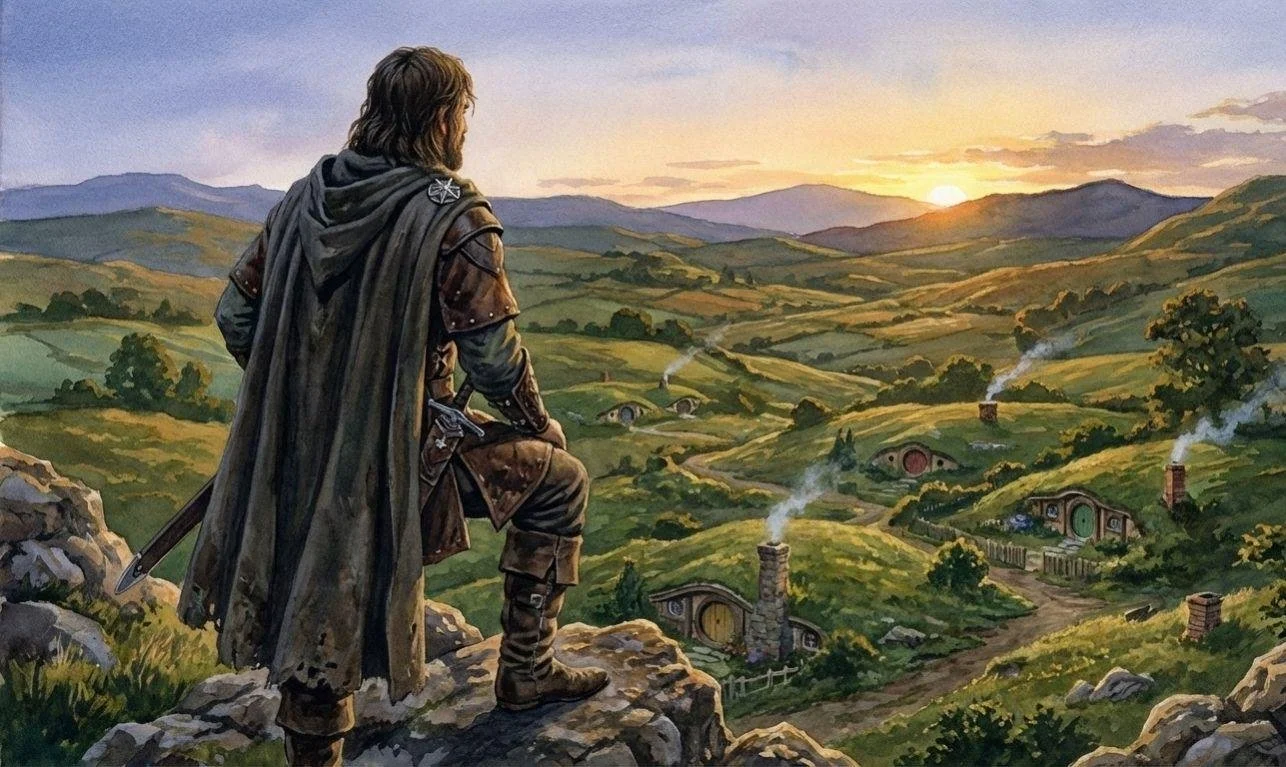
C.S. Lewis wrote the following in his book review of The Lord of the Rings: “Almost the central theme of the book is the contrast between the Hobbits (or 'the Shire') and the appalling destiny to which some of them are called, the terrifying discovery that the humdrum happiness of the Shire, which they had taken for granted as something normal, is in reality a sort of local and temporary accident, that its existence depends on being protected by powers the Hobbits dare not imagine, that any Hobbit may find himself forced out of the Shire and caught up into that high conflict. More strangely still, the event of that conflict between the strongest things may come to depend on him who is almost the weakest.” The illusion of safety and peace is starting to evaporate as we who grew up in the West are beginning to wake up from our reverie. In other words, dark forces of bondage like the Nazgûl and all they represent are wandering through our shire, disrupting the quiet tranquility that once resided here.
One concrete example in the Canadian context is Bill C-9; if passed, it would remove Scripture from all religions as a legitimate defence for an alleged hate crime in court. There are many other examples, including compelled speech laws and criminalizing as hate speech what would have been considered normal speech a decade ago, especially in the UK. Criminals are not brought to justice, and politicians stir up hate and division with gaslighting, lies, and Saruman-esque voices like never before. The innocent suffer for it. And yet, though it may seem bleak and men be weak, we believe we are called to a higher purpose.
Is the West under threat?
What does it mean to be a Man of the West?
In Tolkien’s Middle-Earth, the Shire was defended and watched over by mysterious men called Rangers: grizzled wanderers, remnants of a kingdom long forgotten. They called themselves the Dunédain, which means Men of the West—the name from which our group derives. Even though their kingdom was a faded memory of the past, they diligently and dutifully continued protecting the carefree inhabitants of the Shire from danger, generation after generation.
In The Fellowship of the Ring, Frodo asks Gandalf, “‘Do you really mean that Strider is one of the people of the old Kings?’ said Frodo in wonder. ‘I thought they had all vanished long ago. I thought he was only a Ranger.’”
“‘Only a Ranger!’ cried Gandalf. ‘My dear Frodo, that is just what the Rangers are: the last remnant in the North of the great people, the Men of the West. They have helped me before; and I shall need their help in the days to come…’”
Just as the Shire’s inhabitants forgot about the Dunédain and the just kingdom that once had peaceful dominion over Middle-Earth, so we have largely forgotten our own values and rich history as our world begins to descend into chaos. In Live Not by Lies, Rod Dreher says, “simply by staying sane when everyone else is mad, we may hope to convey the human heritage” (p. 127). Men of the West therefore uphold certain precepts while also standing against incompatible values in the name of sanity, hope, and heritage. We seek to explore what it means to be a Man of the West and come to a consensus together before enshrining it on this page when the time is right.
As the Overton window of acceptability closes further in our society, we must be prepared for the eventuality that we may be fully unable to speak openly and publicly about what we believe without dire consequences. This has happened many times throughout history, including in the West. Whether it was under a fascist dictatorship, communist state, absolute monarchy, or totalitarian theocracy, keepers of the flame often had to speak in secret. We ascribe to Václav Benda’s concept of parallel polis: a parallel city or society that operates underground when it is impossible to speak openly in mainstream society. In order for the West to survive, we believe that it is crucial to host such cultural, intellectual, and philosophical discussions in this way to prepare for the possibility of overwhelming government censorship on the horizon this decade. The parallel polis preserves cultural memory and allows us to yearn in hope for a better future instead of withering in isolation.
Is the West worth defending?
On the one hand, modern Western culture has led to extreme individualism bordering on narcissism, atomization, loneliness, and societal fracturing. But the West has also given us some unarguably good things. One goal of our group is to redeem and baptize the West by deciding together what are the best qualities to preserve and which should be discarded. So what is worth preserving? The peace and prosperity that we have enjoyed is absolutely worth defending. More than that, the very idea that human life has value and that every individual matters is worth preserving. Not every culture believes that. To believe in the West is to believe that this gift of life and prosperity is for everyone, should they choose it; it’s not for a select few. Finally, we have an obligation to our descendants to leave our culture better than we found it. To survive, the West cannot exactly return to how it was at some arbitrary point in time; it must adapt to changes in technology, geopolitics, new scientific information, and new ideas. But it must also stay true to the foundational properties that made the West free and successful in the first place. We therefore challenge men to take on the noble responsibility of beginning to redeem the West by first learning more about the wise words of those who came before us. Will you join us?